 Maximise IT support impact with digital transformation">
Maximise IT support impact with digital transformation
TL;DR:
- Successful digital transformation shifts IT support from reactive to proactive, AI-driven models.
- Key technology drivers include AI automation, ITSM platforms, and enterprise service management.
- Measurable outcomes show significant improvements in resolution time, employee satisfaction, and ROI.
Most IT leaders assume digital transformation in IT support is fundamentally about deploying new tools. Swap the old ticketing system for a modern one, add a chatbot, call it done. But that framing misses the real shift entirely. The organisations seeing measurable gains are not those that upgraded technology. They are the ones that reimagined how support is delivered, moving from reactive firefighting to proactive, AI-driven models that anticipate problems before employees even notice them. This article covers the frameworks, outcomes, and pitfalls that define successful digital transformation in IT support, so your enterprise can make confident, well-informed decisions.
Table of Contents
- From reactive to proactive: The evolution of IT support
- The technology drivers powering digital transformation
- Real-world gains and measurable outcomes
- Pitfalls, edge cases, and governance: Making transformation sustainable
- Our perspective: Why digital transformation in IT support demands enterprise pragmatism
- Enhancing your IT support transformation with Velocity Smart
- Frequently asked questions
Key Takeaways
| Point | Details |
|---|---|
| Transform support models | Moving from reactive to proactive, AI-driven IT support delivers scalability and efficiency. |
| Leverage the right technology | Choose autonomous solutions that match enterprise governance and engagement needs. |
| Focus on measurable outcomes | Track MTTR, CSAT, and ROI to ensure digital transformation delivers real value. |
| Prepare for pitfalls | Beware of over-customisation and maintain governance to ensure sustainable change. |
From reactive to proactive: The evolution of IT support
For decades, enterprise IT support followed a familiar pattern. Employees raised tickets. Agents triaged them. Issues escalated through tiers. Resolution happened when a human with the right knowledge eventually got involved. This model was built for a world where most employees worked in the same building as the IT team.
That world no longer exists. Hybrid and remote work have fundamentally changed the support equation. Teams are distributed across cities, time zones, and home offices. The sheer volume of devices and endpoints has multiplied. Legacy tiered support simply cannot scale to meet this reality without burning out IT staff and frustrating employees.
The strategic response is a shift toward proactive, autonomous support. Rather than waiting for employees to raise tickets, modern IT environments use AI-driven diagnostics, predictive monitoring, and automated remediation to resolve issues before they surface. The future of IT support is no longer a help desk. It is an intelligent service layer embedded across the organisation.
The evidence supports this shift clearly:
- Reduced MTTR (mean time to resolution): AI-driven models dramatically cut the time between issue detection and resolution.
- Lower ticket backlogs: Automation handles repeat, low-complexity requests without human intervention.
- Improved DEX (digital employee experience): Faster resolution and self-service options reduce friction for end users.
- Greater visibility: Dashboards and analytics give IT leaders a real-time view of service health across all sites.
Digital transformation shifts IT support from reactive, tiered models to proactive, AI-driven autonomous support, reducing MTTR and ticket volumes while improving DEX. At the same time, service operations form the backbone of digital transformation by enabling productivity, automation, standardisation, and visibility across hybrid work environments.
“The goal is not to automate the old model. It is to engineer a new one that treats employee productivity as a first-class outcome.”
The IT Support Survey 2026 reinforces this, showing that standardisation and employee experience have become primary drivers of IT investment, outranking cost reduction for the first time.
With the foundation of shifting service delivery understood, the next question is: what technology makes these transformations possible?
The technology drivers powering digital transformation
The technology stack behind modern IT support transformation is more nuanced than simply deploying AI. There are distinct layers, each with a specific role.

AI and automation sit at the core. Natural language processing handles first-contact queries. Machine learning models predict failure patterns in hardware and software. Robotic process automation (RPA) takes care of repetitive tasks like account unlocks, password resets, and software provisioning. The combined effect is a dramatic reduction in manual ticket handling, freeing skilled engineers for complex, high-value work.
ITSM platforms provide the governance layer. The two dominant players are ServiceNow and Salesforce, and they approach the problem differently. AI capabilities in platforms like ServiceNow and Salesforce Agentforce enable agentic AI for orchestration and engagement, reducing manual work across the IT function.
| Feature | ServiceNow | Salesforce Agentforce |
|---|---|---|
| Primary strength | Governance and orchestration | Customer and employee engagement |
| AI approach | Orchestration-first | Engagement-first |
| Integration depth | Enterprise service management | CRM and service cloud |
| Best suited for | Complex, regulated enterprises | Organisations prioritising CX |
Enterprise Service Management (ESM) extends ITSM principles beyond IT into HR, facilities, and finance. When IT automation integrates with ESM, workflows become seamless across the business. An employee returning a faulty device, for example, can trigger a replacement request, an asset management update, and a facilities notification, all without manual input.
Emerging orchestration agents are also reshaping how automation decisions are made. Rather than following fixed rules, these agents reason across context, adjust dynamically, and escalate only when genuinely uncertain. Combined with proactive IT support automation, this creates a support environment that learns and improves over time.
For enterprises monitoring IT automation trends, the direction is clear: AI is moving from assistant to active participant in service delivery. Security automation is also accelerating, with AI in security automation increasingly embedded within ITSM workflows to detect anomalies and enforce compliance in real time.
Pro Tip: When evaluating ITSM platforms, anchor your shortlist to three measurable metrics: MTTR, CSAT (customer satisfaction score), and cost per ticket. Any platform that cannot demonstrate improvement across all three within twelve months of deployment deserves scrutiny.
Real-world gains and measurable outcomes
The business case for digital transformation in IT support is no longer theoretical. Enterprise case studies now offer detailed, auditable evidence of what is achievable.
Consider these headline outcomes:
- Vermeer achieved 50% faster resolution times alongside a 95% CSAT score after transforming their IT support operations.
- Atlassian ITSM delivered a 275% ROI and $2.3 million in savings, with total benefits reaching $9.5 million.
- Vera Bradley cut ticket triage time by 50%, freeing their IT team to focus on strategic initiatives rather than administrative sorting.
Before and after: Enterprise IT support transformation
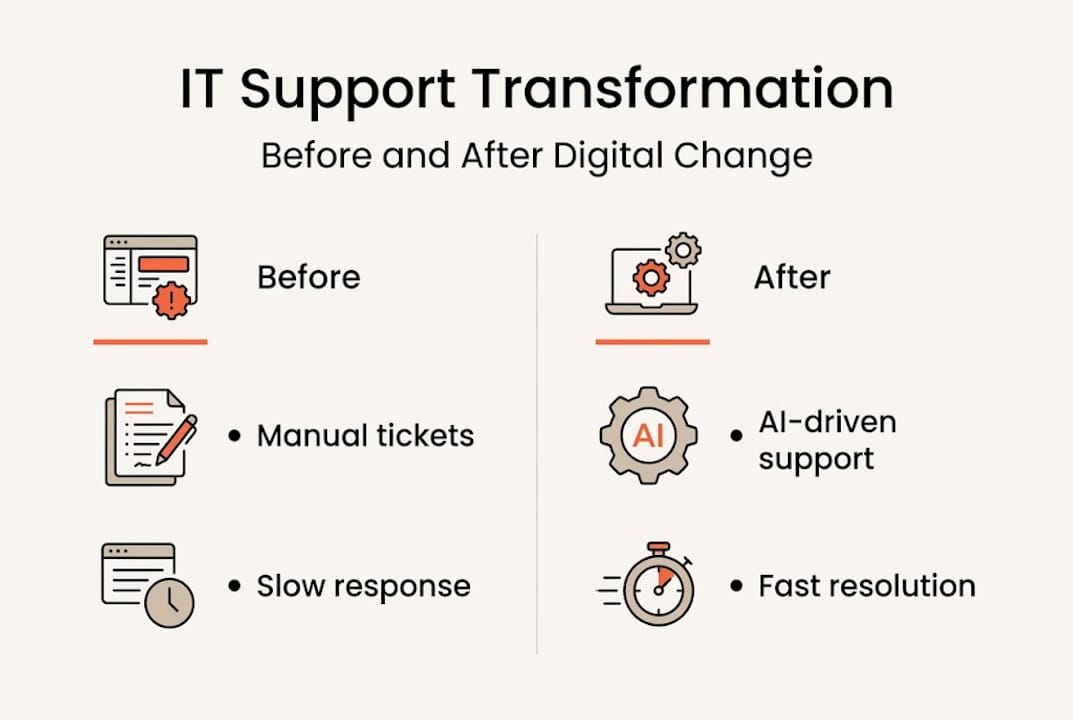
| Metric | Before transformation | After transformation |
|---|---|---|
| Mean time to resolution | 48 to 72 hours | 12 to 24 hours |
| Ticket triage time | Manual, 2 to 4 hours | Automated, under 30 minutes |
| CSAT score | 70 to 75% | 90 to 95% |
| Cost per ticket | £35 to £50 | £12 to £20 |
| ROI from automation | Not measured | 200 to 275% within 24 months |
These outcomes do not happen by accident. They follow a deliberate sequence of automation steps for IT support:
- Audit existing workflows to identify the highest-volume, lowest-complexity requests.
- Automate tier-one tasks first, using AI to handle password resets, access requests, and device queries.
- Integrate asset management so device status is visible in real time across all locations.
- Deploy self-service options that empower employees to resolve common issues without contacting IT.
- Measure and iterate using MTTR, CSAT, and cost-per-ticket data to guide continuous improvement.
Employee experience improvements are just as significant as the operational metrics. When AI in ITSM resolves issues faster and more consistently, employee trust in IT increases. That trust reduces shadow IT and improves adoption of approved tools.
While these results are compelling, not all digital transformation journeys are smooth. Understanding the limitations and pitfalls is equally important.
Pitfalls, edge cases, and governance: Making transformation sustainable
For every Vermeer and Vera Bradley, there are enterprises that launched ambitious IT transformation programmes and stalled. Understanding why is as valuable as celebrating the successes.
Over-customisation is one of the most common traps. Organisations modify their ITSM platforms so heavily that every platform upgrade becomes a costly, time-consuming project. The service trap is real: teams customise to solve today’s problem and unknowingly create tomorrow’s technical debt.
Common pitfalls to anticipate include:
- Legacy data noise: Old systems contain inconsistent, incomplete data. Feeding this into AI models produces inaccurate recommendations and erodes trust in automation.
- Resistance from reactive mindsets: Teams accustomed to firefighting often struggle to adopt proactive models, viewing automation as a threat rather than a tool.
- AI governance gaps: Pure autonomy without human oversight creates risk. AI systems can make confident but incorrect decisions, particularly in regulated industries.
- Lift-and-shift failures: Replicating old, broken processes inside new technology does not constitute transformation. It just moves the problem.
“Governance is not the enemy of innovation. It is what allows innovation to be sustained at enterprise scale.”
Remote IT support lessons from the pandemic reinforced this point sharply. Organisations that invested in governance frameworks before scaling automation outperformed those that moved fast without guardrails.
Pro Tip: When planning automation, map your value flows first. Identify where delays cause the most business impact and start there. Automating for automation’s sake, without tying initiatives to clear business outcomes, is one of the fastest routes to a failed transformation.
A governance framework should define clear escalation paths, human override protocols, bias auditing for AI models, and regular reviews of automated decision accuracy. These are not optional extras. They are the difference between a transformation that scales and one that creates new forms of risk.
Our perspective: Why digital transformation in IT support demands enterprise pragmatism
The most instructive lesson from enterprise IT transformations is not about technology. It is about priorities. The programmes that fail almost always share a common trait: they started with a tool in mind rather than a business outcome.
We see this consistently. An enterprise adopts a leading ITSM platform, invests heavily in configuration, and then measures success by deployment speed rather than resolution time or employee satisfaction. The technology works. The transformation does not.
Pragmatic transformation starts with asking what problem you are actually solving for employees and the business, not which features excite the vendor. Frameworks like enterprise IT efficiency principles and value-based KPIs force this discipline. They anchor every automation decision to a measurable outcome.
Change management and sustained governance are not softer concerns to address later. They are structural requirements. The enterprises that achieve 275% ROI did not get there by deploying great software alone. They built cultures where IT teams, business stakeholders, and leadership aligned on what success looks like before the first workflow was automated.
Enhancing your IT support transformation with Velocity Smart
If the insights in this guide resonate with the challenges your organisation faces, the logical next step is identifying solutions that operationalise these principles at scale.
Velocity Smart Technology’s Smart IT Support Kiosk enables enterprises to provide real-time remote IT support, secure device diagnostics, and equipment exchange across distributed workplaces without requiring onsite technicians. Built natively on ServiceNow, our platform eliminates data silos, reduces manual processes, and integrates directly with existing ITSM workflows. For IT leaders ready to move from reactive support to proactive, automated service delivery, explore our Automation Unboxed solutions and discover how Velocity Smart accelerates measurable enterprise outcomes.
Frequently asked questions
What are the main benefits of digital transformation in IT support?
It enables faster problem resolution, reduces ticket volumes, and improves employee experience through automation and AI-driven support. MTTR reduction and DEX improvement are among the most consistently reported gains across enterprises.
How do ServiceNow and Salesforce differ for enterprise IT support?
ServiceNow prioritises governance and orchestration, while Salesforce Agentforce focuses on engagement. ServiceNow’s governance focus makes it particularly well-suited to complex, regulated enterprise environments.
What challenges do enterprises face in IT support digital transformation?
Common issues include over-customisation, legacy integration problems, AI governance gaps, and overcoming reactive service mindsets. Over-customisation and legacy data noise are among the most frequently cited obstacles in enterprise programmes.
How can success be measured in IT support transformation?
Key metrics include MTTR, cost per ticket, CSAT, and ROI from cost savings. Tracking MTTR, CSAT, and ROI together provides a balanced view of both operational and employee experience outcomes.
Recommended
See what Smart Collect® could save you
Model your savings in two minutes, or book a 60-minute workshop to pressure-test the numbers against your estate.