 How to improve equipment management for IT success">
How to improve equipment management for IT success
TL;DR:
- Effective equipment management requires honest assessment, stakeholder alignment, and clean data.
- Implement phased automation with proper tools, KPIs, and continuous measurement for improvement.
- Cultural accountability and ongoing review are crucial for lasting success in equipment management.
When a laptop goes missing at a remote office, or an employee waits three days for a replacement device because nobody knows where the spare stock is, the cost is rarely just financial. Productivity stalls, frustration mounts, and your IT team spends time firefighting instead of delivering value. Across large enterprises with distributed workplaces, these moments happen constantly, and they compound quickly. This guide walks you through a practical, step-by-step approach to assessing your current equipment management challenges, building the right foundations, implementing modern tools, and measuring what actually improves.
Table of Contents
- Assessing your current equipment management challenges
- Preparing for transformation: Tools and prerequisites
- Step-by-step process to implement modern equipment management
- Troubleshooting, measuring outcomes, and optimising
- Our perspective: Why most equipment management strategies still fall short
- Transform your IT equipment management with Velocity Smart
- Frequently asked questions
Key Takeaways
| Point | Details |
|---|---|
| Diagnose pain points | Identify gaps and inefficiencies in your existing equipment management process before acting. |
| Leverage technology integration | Integrate AI, automation, and monitoring tools for predictive and efficient management. |
| Follow clear steps | Apply a structured, phased approach for successful and sustainable transformation. |
| Continuously optimise | Use metrics and feedback loops to troubleshoot and improve management practices over time. |
Assessing your current equipment management challenges
Before you can fix anything, you need an honest picture of where things stand. Most large enterprises carry more equipment management debt than they realise. Devices go untracked between offices, licences are paid for on hardware that was retired months ago, and compliance audits reveal gaps that nobody anticipated.
The most common struggles IT operations teams report include:
- Lack of visibility across sites, meaning nobody knows where assets are at any given time
- Device loss and ghost assets that remain on the books long after they have left the building
- Unplanned downtime caused by equipment failures that could have been predicted and prevented
- Compliance and security risks from unmanaged or unpatched devices sitting in circulation
- Slow distribution that leaves new starters or remote workers waiting days for equipment
The financial impact of these gaps is significant. Unmanaged assets inflate procurement budgets because teams buy new equipment rather than recovering what already exists. Poor tracking asset locations leads directly to duplicate spending and audit failures. The centralised tracking benefits of a single source of truth are well documented, yet many organisations still rely on spreadsheets or disconnected systems.
A useful starting point is applying the 5 P’s framework to your current state. Hardware Asset Management (HAM) uses Planning, People, Processes, Performance, and Portfolio as lenses to evaluate where your lifecycle management is strong and where it breaks down.
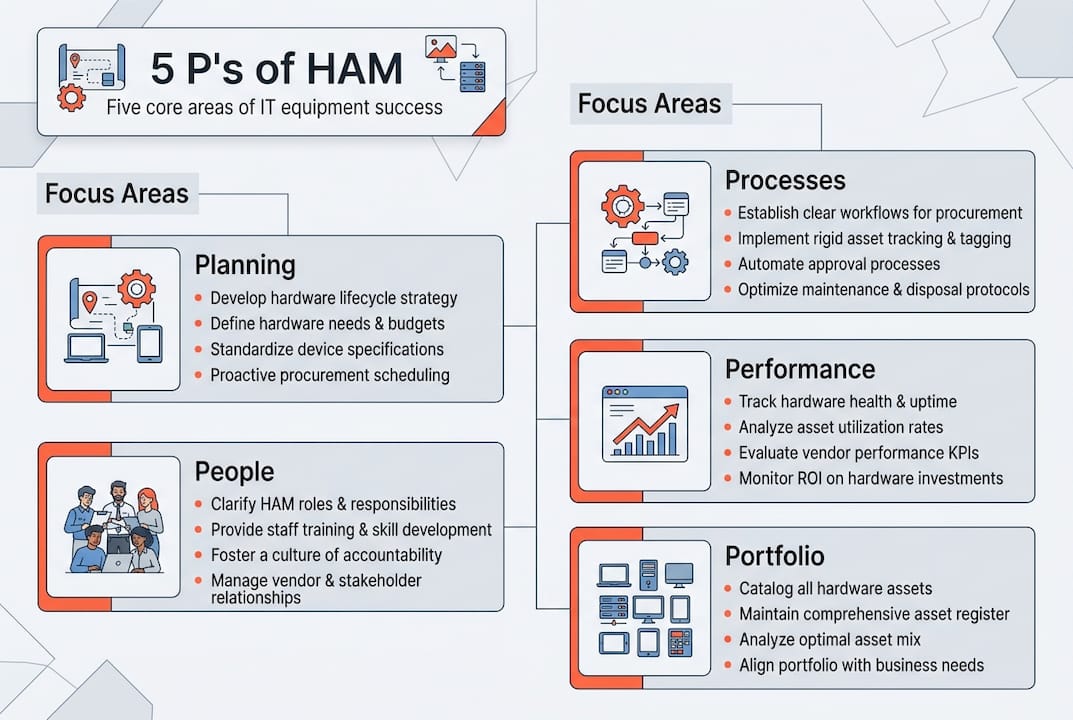
| Assessment area | Common gap | Business impact |
|---|---|---|
| Planning | No lifecycle roadmap | Reactive procurement, budget overruns |
| People | Unclear ownership | Assets lost between teams |
| Processes | Manual, inconsistent workflows | Errors, delays, compliance failures |
| Performance | No KPIs tracked | No visibility of improvement |
| Portfolio | Outdated asset register | Ghost assets, wasted spend |
Running this assessment honestly, even informally, gives you a structured starting point. It also helps you build the business case for change, which is essential when you need leadership buy-in for investment in new tools or processes.
Preparing for transformation: Tools and prerequisites
Once you understand your gaps, the temptation is to jump straight to purchasing new software. Resist it. The organisations that get the most from equipment management transformation are those that do the groundwork first.
Start by taking stock of what you already have. Many enterprises own ITSM platforms, monitoring tools, and asset management modules that are underused or poorly configured. Before adding new technology, understand what your current stack can actually do.
Key tools to evaluate include:
- ITSM platforms such as ServiceNow, which can serve as a central hub for asset data, workflows, and automation
- Monitoring and AIOps tools that provide real-time visibility into device health and usage
- Endpoint management solutions for tracking and managing devices across distributed sites
- Automation platforms that can trigger workflows based on asset events, such as a device reaching end of life
Integrating these tools is where the real value emerges. Integrating HAM with AIOps enables predictive maintenance and lifecycle optimisation, while AI within platforms like ServiceNow can flag compliance risks before they become audit failures. Reviewing IT asset management best practices will help you identify which capabilities to prioritise.

Stakeholder alignment is equally important and often underestimated. IT, finance, procurement, HR, and facilities all touch equipment in some way. If these teams are not aligned on data standards, ownership rules, and process expectations, even the best technology will produce inconsistent results.
Data quality is your other prerequisite. Automated tools can only work with the information they are given. If your asset register is incomplete or out of date, clean it before you automate it. Garbage in, garbage out is a cliché because it is true.
| Prerequisite | Why it matters | First action |
|---|---|---|
| Stakeholder alignment | Prevents conflicting data and ownership gaps | Map all teams that touch assets |
| Clean asset data | Ensures automation works accurately | Audit and reconcile your register |
| Platform integration | Unlocks predictive and automated workflows | Assess current tool connectivity |
| Defined KPIs | Gives you a baseline to measure against | Agree metrics before you start |
Pro Tip: Before selecting any new platform, run a two-week shadow audit. Have someone manually track every equipment request, return, and query that comes through your IT desk. The patterns you find will tell you exactly where automation will have the greatest impact.
Keeping pace with automation trends in IT is not about chasing every new tool. It is about understanding which capabilities solve your specific, documented problems.
Step-by-step process to implement modern equipment management
With your assessment complete and your prerequisites in place, you are ready to move into implementation. A phased approach reduces risk and gives your teams time to adapt.
-
Define your target state. Before touching any system, document what good looks like. How quickly should equipment reach an employee? What does a compliant asset record contain? What does a zero-touch distribution process look like for your organisation?
-
Engage stakeholders early. Bring IT, finance, HR, and facilities into the process from the start. Assign clear ownership for each asset category and agree on escalation paths when things go wrong.
-
Select your platform and integrations. For most large enterprises, ServiceNow is the natural hub. ServiceNow ITAM improves asset tracking by 40% and reduces software licence costs by 30%, while cutting security risks by 50% and boosting operational efficiency by 70%. These are not incremental gains. They represent a fundamental shift in how IT operations performs.
-
Pilot in one location. Choose a site with a mix of asset types and a motivated local IT contact. Run the new process for four to six weeks, gather feedback, and refine before rolling out more broadly.
-
Automate distribution and returns. This is where physical automation tools, such as smart lockers and vending solutions, become powerful. Following clear IT support automation steps ensures that employees can collect and return devices without manual intervention, reducing queue times and eliminating lost handover records.
-
Integrate with ServiceNow workflows. If you want to automate equipment issue with ServiceNow, the key is mapping your current manual steps and replacing each one with a triggered workflow. Every collection, return, and replacement should update the asset record automatically.
-
Train and communicate. Technology without adoption is waste. Run short, practical training sessions for both IT staff and end users. Make the new process easier than the old one, and people will use it.
Pro Tip: Measure your baseline before go-live. Record average device collection time, number of lost assets per quarter, and help desk ticket volume related to equipment. You will need these numbers to demonstrate ROI.
Troubleshooting, measuring outcomes, and optimising
Deployment is not the finish line. The organisations that sustain improvement are those that treat equipment management as a living process, not a one-time project.
Start with a clear set of KPIs. Track metrics that reflect both operational performance and employee experience:
- Mean time to equipment (how long from request to device in hand)
- Asset tracking accuracy (percentage of assets with a confirmed, current location)
- Licence compliance rate (proportion of software licences matched to active users)
- Help desk ticket volume for equipment-related issues
- Device loss rate per quarter
Dashboards should make these metrics visible to both IT leadership and the teams responsible for day-to-day management. When a metric moves in the wrong direction, you want to know within days, not at the next quarterly review.
“The difference between organisations that sustain improvement and those that plateau is not the quality of their tools. It is whether they have built a habit of reviewing the data and acting on it.”
Common errors to watch for after go-live include:
- Poor data hygiene where new assets are added without following the agreed record format
- Lack of user training leading staff to work around the new process rather than through it
- Integration drift where updates to one platform break connections with another
- Scope creep where the programme expands faster than the team can support
Reducing asset loss requires consistent process adherence, not just better technology. And as your confidence grows, smart vending in asset support offers a practical way to extend automated distribution to more sites without scaling headcount.
| KPI | Target benchmark | Review frequency |
|---|---|---|
| Mean time to equipment | Under 2 hours | Weekly |
| Asset tracking accuracy | Above 95% | Monthly |
| Licence compliance rate | Above 98% | Monthly |
| Equipment ticket volume | Down 40% from baseline | Quarterly |
AI-driven analytics within your ITSM platform can surface patterns that human reviewers miss, such as device failure clusters in a particular office or licence usage that suggests a category of software is underutilised. Use these insights to drive continuous improvement cycles rather than waiting for problems to escalate.
Our perspective: Why most equipment management strategies still fall short
Here is an uncomfortable observation. Most equipment management initiatives fail not because of poor technology choices, but because organisations treat the problem as purely technical. They implement a new platform, declare success at go-live, and move on. Six months later, the data is dirty, the workflows are being bypassed, and the help desk is fielding the same equipment queries it always did.
The real differentiator is cultural. Who owns the asset record when something goes wrong? Is there a named person accountable for data quality in each region? Does leadership review equipment management metrics with the same rigour as financial KPIs?
Following enterprise automation trends matters, but technology is an enabler, not a solution. The organisations that achieve lasting improvement build clear accountability structures, invest in ongoing training, and treat equipment management as a continuous service rather than a project with an end date. That shift in mindset is harder than any implementation, and it is the only thing that makes the results stick.
Transform your IT equipment management with Velocity Smart
If the steps in this guide feel like the right direction but the implementation feels daunting, you do not have to build it all from scratch. Velocity Smart Technology provides intelligent automation solutions designed specifically for large enterprises managing equipment across distributed workplaces.
From enterprise IT support kiosks that enable employees to collect, return, and troubleshoot devices without waiting for a technician, to smart IT vending solutions that automate equipment distribution at scale, our platform works natively within your ServiceNow instance. There are no additional data platforms, no GDPR complications, and no manual re-keying. Visit Velocity Smart to see how enterprises across financial services, healthcare, and government are reducing costs and improving employee experience today.
Frequently asked questions
What are the five P’s of hardware asset management?
The five P’s are Planning, People, Processes, Performance, and Portfolio, covering all aspects of the IT equipment lifecycle from procurement through to disposal.
How much can ServiceNow ITAM improve asset tracking?
ServiceNow ITAM improves tracking by 40% while also reducing software licence costs by 30% and cutting security risks by half.
What is the role of AI in equipment management?
AI enables predictive maintenance and compliance monitoring, helping IT teams identify issues before they cause downtime or audit failures.
How do you measure the success of equipment management improvements?
Success is measured using KPIs such as mean time to equipment, asset tracking accuracy, licence compliance rate, and help desk ticket volume related to equipment queries.
Recommended
- IT Asset Management: Driving Efficiency in Fortune 500 Enterprises
- The True Costs of IT Inefficiency
- Smart Vending Machines: Transforming IT Asset Support
- Bigger Lockers: Enhancing IT Asset Automation
- Infrastructure Management: Driving Efficiency in U.S. IT | Ailerons IT Consulting
- IT Security Management System: Enhancing Trust and Efficiency
See what Smart Collect® could save you
Model your savings in two minutes, or book a 60-minute workshop to pressure-test the numbers against your estate.