 ITSM physical automation: a practical enterprise guide">
ITSM physical automation: a practical enterprise guide
TL;DR:
- ITSM physical automation combines AI-driven workflow orchestration with physical devices to execute hardware tasks automatically. Enterprises face challenges like the Context Gap, safety risks, and siloed systems, which require integrated data, safety rules, and governance to overcome. Implementing formal architecture and monitoring improves outcomes such as increased throughput, faster fulfillment, and reduced equipment loss.
ITSM physical automation is the integration of automated physical devices, AI-driven workflow orchestration, and deterministic rules within IT service management processes to execute hardware-related tasks without human intervention. Where traditional IT service management automation handles tickets, approvals, and notifications in software, physical automation extends those workflows into the real world: unlocking a locker to deliver a laptop, dispensing a peripheral from a vending unit, or controlling a data centre environment. The gap between digital and physical automation is where enterprise IT costs accumulate. Desktop support tickets cost roughly three times more than digital ones, and that gap widens as AI collapses digital costs toward zero. Closing it requires a disciplined architecture, not just connected hardware.
How does ITSM physical automation work?
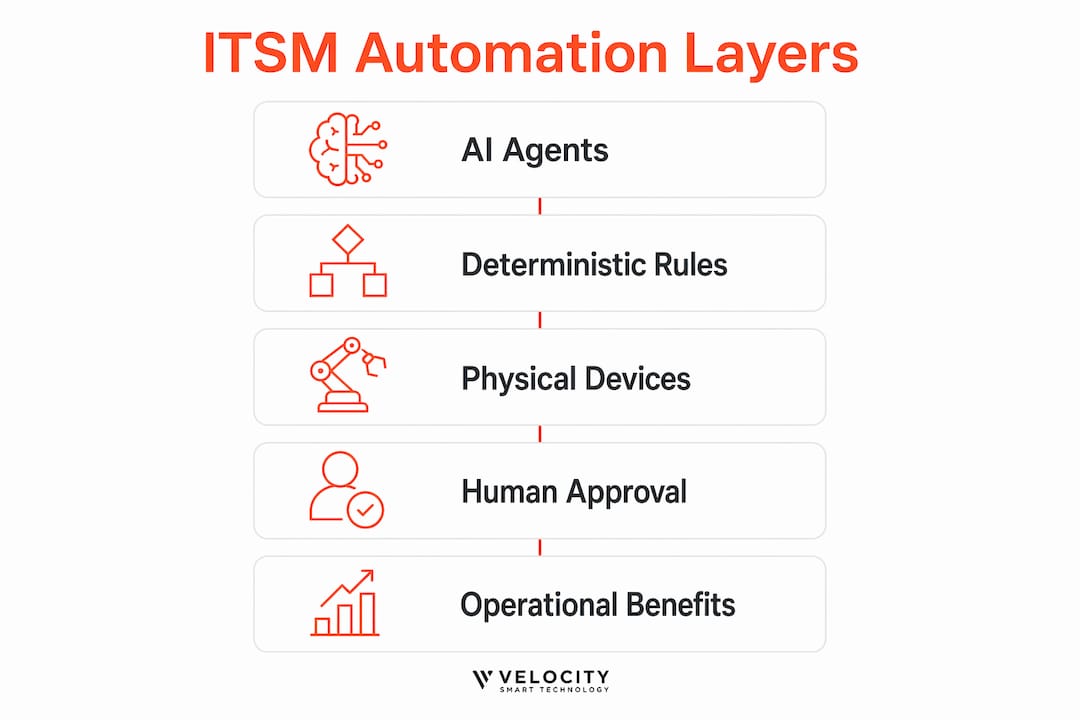
ITSM physical automation operates across three distinct layers: AI agents, deterministic rules, and physical actuation endpoints. Each layer has a defined role, and the separation of those roles is what makes the architecture safe and auditable at enterprise scale.
AI agents interpret and reason, deterministic rules enforce compliance, and humans approve high-stakes decisions. This separation is not a design preference. It is the operational foundation that allows automation to scale without introducing unacceptable risk. An AI agent can assess a service request, identify the correct device, and trigger a locker release. A deterministic rule can override that release if the door has been open beyond a permitted time limit, regardless of what the AI decided.
Physical endpoints connect to the ITSM platform through protocols such as MQTT and Model Context Protocol (MCP). MQTT and MCP enable cloud AI agents to access real-time device status and inventory data for accurate task execution. Without that real-time feed, an AI agent is reasoning from stale data, which produces errors at the physical layer where errors have tangible consequences.
The table below summarises how each component contributes to the overall architecture.
| Component | Primary role | Authority level |
|---|---|---|
| AI agent | Interprets requests, reasons, orchestrates multi-step workflows | Advisory and operational |
| Deterministic rules | Enforce compliance, safety limits, and policy boundaries | Override authority |
| Human review | Approves high-risk or irreversible physical actions | Final authority |
| Physical endpoint | Executes the physical action (locker, vending, kiosk) | Execution only |
Pro Tip: Map your existing ITSM workflows against each of these four layers before selecting hardware. Gaps in the deterministic rules layer are the most common cause of failed physical automation deployments.
What challenges do enterprises face with physical automation in ITSM?
The single largest barrier to effective physical automation is the Context Gap. The Context Gap is the absence of real-time visibility into physical asset states, which renders AI automation unreliable. Combining IT asset management with ITSM is the structural fix, not a workaround.
Safety is the second major concern. Physical actions are irreversible in ways that software actions are not. A misconfigured approval workflow that sends the wrong notification is recoverable. A locker that releases a device to the wrong person is not. Tiered authority architectures address this by using safety rules to override AI decisions, ensuring compliance and preventing unsafe physical automation actions. A time limit on a locker door, for example, overrides any AI command regardless of the automation’s intent.
Scalability introduces a third challenge. Enterprises that deploy physical endpoints as standalone systems, disconnected from their ITSM platform, create automation silos. Those silos generate their own audit trails, their own asset records, and their own approval queues. The result is fragmentation that grows more expensive to manage as the estate expands.
Best practices for avoiding these pitfalls:
- Eliminate the Context Gap first. Integrate IT asset management data into your ITSM platform before connecting physical devices. Automation built on incomplete asset data fails at scale.
- Define deterministic safety rules before go-live. Safety overrides must be configured independently of AI logic and tested against edge cases.
- Treat physical endpoints as ITSM extensions, not separate systems. Asset records, audit trails, and approval workflows must live in the ITSM platform, not in device-specific software.
- Build in human-in-the-loop checkpoints for high-risk actions. Device handovers involving sensitive equipment or regulated data require human approval gates, even in a largely automated workflow.
- Monitor physical endpoint health continuously. A locker with a faulty sensor or a vending unit with an empty bay produces service failures that look like workflow failures. Real-time telemetry prevents misdiagnosis.
Pro Tip: Run a tabletop exercise simulating a physical automation failure before deployment. Identify which deterministic rules would catch the failure and which would not. The gaps you find are your configuration backlog.
What are the practical benefits of ITSM physical automation?
The operational benefits of automated IT service processes at the physical layer are measurable and significant. ITSM automation replaces manual routine steps with faster, consistent routing, approvals, notifications, and resolutions, freeing IT staff for complex activities. When that automation extends to physical device handling, the time savings compound.

Velocity-smart customers demonstrate what this looks like in practice. A global pharmaceutical customer recorded a 500% uplift in IT service throughput and 83% faster fulfilment after deploying automated physical handover workflows. A US nuclear energy operator cut on-site tickets by 60% and reclaimed 31–42% of IT staff time. A UK utility reduced shared-equipment loss and damage by 90%. These outcomes were achieved using traditional ITSM workflows, before agentic AI was driving the process end-to-end.
At the infrastructure level, multi-agent context-aware frameworks in smart environments can reduce energy consumption by 45–60% while increasing system responsiveness. That figure reflects what happens when physical environment control is governed by AI agents with real-time data rather than static schedules.
AI-driven ITSM automation also accelerates incident diagnosis, automates routine service requests, and reduces mean time to resolution (MTTR). Faster MTTR translates directly to SLA compliance improvements and reduced employee downtime, both of which carry quantifiable financial value.
| Benefit | Illustrative outcome |
|---|---|
| IT service throughput | 500%+ uplift (global pharma, Velocity-smart) |
| Fulfilment speed | 83% faster (global pharma, Velocity-smart) |
| On-site ticket volume | 60% reduction (US nuclear energy, Velocity-smart) |
| IT staff time reclaimed | 31–42% (US nuclear energy, Velocity-smart) |
| Equipment loss and damage | 90% reduction (UK utility, Velocity-smart) |
| Energy consumption | 45–60% reduction (smart environment study, 2026) |
How to implement and scale ITSM physical automation
Successful implementation follows a sequenced approach. Skipping steps, particularly the foundational ones, produces deployments that work in pilots and fail at scale.
-
Establish your ITSM platform as the single source of truth. ITSM platforms must remain the authoritative workflow controller, with hardware endpoints acting as extensions rather than isolated silos. Configure asset records, approval workflows, and audit trails in the ITSM platform before connecting any physical device.
-
Integrate real-time asset data. Close the Context Gap by connecting your IT asset management system to your ITSM platform. Physical automation that operates without current asset state data will produce errors that erode trust in the system.
-
Define and test deterministic rules. Write safety rules that govern every physical action: maximum door open times, authorised user lists, device condition thresholds. Test each rule against failure scenarios before go-live.
-
Deploy AI agents within governed boundaries. Agentic AI systems autonomously interpret requests, execute workflows, and validate results within governed boundaries. Configure the boundaries first, then activate the agents.
-
Configure human-in-the-loop approval gates. Identify which physical actions carry irreversible consequences and require human sign-off. Build those gates into the workflow, not as exceptions but as standard process steps.
-
Monitor, measure, and iterate. Track MTTR, SLA compliance rates, physical endpoint uptime, and ticket deflection rates from the first day of operation. Use that data to refine deterministic rules and expand automation scope incrementally.
For enterprises scaling across multiple sites, scalable physical automation depends on maintaining the ITSM platform as the authoritative source and avoiding device-specific automation silos. A consistent governance model applied across all sites is more reliable than site-by-site customisation.
Key takeaways
Effective ITSM physical automation requires a role-based architecture combining AI agents, deterministic safety rules, and human oversight, all governed through the ITSM platform as the single source of truth.
| Point | Details |
|---|---|
| Architecture is the foundation | Separate AI reasoning, deterministic rules, and human approval into distinct layers before deploying hardware. |
| Close the Context Gap first | Integrate real-time asset data into your ITSM platform before connecting physical endpoints. |
| Safety rules override AI | Deterministic rules must supersede AI decisions for any physical action with irreversible consequences. |
| Outcomes are measurable | Enterprises report 500%+ throughput gains and 60% reductions in on-site tickets from physical automation. |
| Scale requires governance | Physical endpoints must extend the ITSM platform, not operate as separate systems with separate data. |
The layer that AI cannot reach alone
Physical automation in ITSM is the most consequential shift in enterprise IT operations that most organisations are not yet treating as a priority. I have watched enterprises invest heavily in AI-driven ticket triage, natural language service portals, and automated approvals, then leave the physical handover step entirely manual. The result is a workflow that is 80% automated and 100% dependent on a human showing up with a laptop.
The uncomfortable truth is that the physical layer is where the remaining cost sits. As AI collapses the cost of digital service resolution toward zero, the physical handover becomes the dominant line item. Enterprises that treat physical automation as a future consideration are, in practice, choosing to carry an expanding cost burden.
The architecture matters more than the hardware. I have seen deployments fail not because the lockers malfunctioned but because the deterministic rules were never properly defined, or because the asset data feeding the AI agent was three days out of date. The technology works. The governance is where most organisations underinvest.
Trust frameworks are not bureaucratic overhead. They are what allow you to expand automation scope without introducing physical risk. An enterprise that builds tiered authority correctly from the start can add new device types, new sites, and new workflow steps with confidence. One that skips that foundation will hit a ceiling, usually at the point where a physical error causes a visible service failure.
The organisations gaining ground now are those treating physical automation as an integral part of their ITSM architecture, not as a facilities project or a hardware procurement exercise. The window for proactive adoption is open. It will not stay open indefinitely.
— Anthony
How Velocity-smart supports physical automation in ITSM
Velocity-smart builds the physical layer that enterprise ITSM workflows need to close tickets without dispatching an engineer. Smart Collect, the company’s ServiceNow-native platform, orchestrates smart lockers, IT vending machines, and Smart Kiosk™ units from within the customer’s existing ServiceNow tenant. Asset records, audit trails, and approval workflows sit in the customer’s CMDB as native records.
For IT decision-makers evaluating physical automation, Velocity-smart’s Smart Collect platform provides a ServiceNow-certified implementation that inherits existing role-based access controls, security posture, and CMDB configuration from day one. Customers in pharma, defence, energy, and financial services have used it to cut on-site ticket volumes, reclaim IT staff time, and reduce equipment loss at scale. The platform embodies the tiered authority and role-based automation principles described throughout this article, applied to production enterprise environments across Europe, North America, and Asia-Pacific.
FAQ
What is ITSM physical automation?
ITSM physical automation is the use of AI agents, deterministic rules, and automated physical devices, such as smart lockers and vending units, to execute hardware-related IT service tasks without human intervention. It extends IT service management workflows beyond software into physical device handling and environment control.
What is the Context Gap in physical automation?
The Context Gap is the absence of real-time visibility into physical asset states, which prevents AI agents from making accurate decisions. Closing it requires integrating IT asset management data directly into the ITSM platform before connecting physical endpoints.
How do deterministic rules differ from AI decisions in physical automation?
Deterministic rules are fixed safety and compliance constraints that override AI decisions regardless of the AI’s reasoning. For example, a rule limiting how long a locker door stays open will close it even if the AI agent has not completed its workflow.
What outcomes can enterprises expect from physical automation?
Velocity-smart customers report outcomes including a 500% uplift in IT service throughput, 60% reductions in on-site tickets, and 90% reductions in equipment loss. A 2026 study on smart environment control found energy consumption reductions of 45–60% with increased system responsiveness.
How should enterprises start implementing ITSM physical automation?
Enterprises should begin by establishing their ITSM platform as the single source of truth, integrating real-time asset data, and defining deterministic safety rules before connecting any physical hardware. Deploying AI agents within governed boundaries and maintaining human approval gates for high-risk actions are the next critical steps.
Recommended
See what Smart Collect® could save you
Model your savings in two minutes, or book a 60-minute workshop to pressure-test the numbers against your estate.