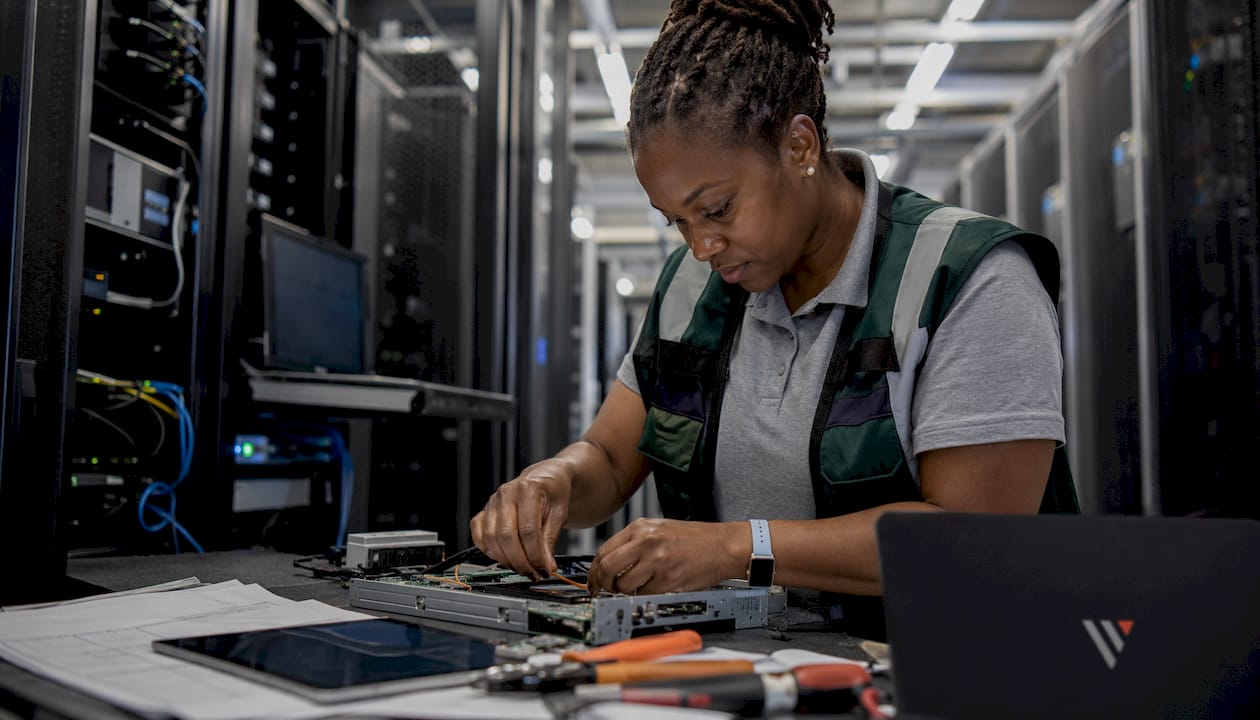
Why AI cannot reach the desk: the physical automation gap
TL;DR:
- AI excels at reasoning and digital ticket management but cannot perform physical device tasks.
- Without native hardware integration, physical workflow automation risks misrouted tickets, asset loss, and compliance failures.
AI is exceptionally capable at reasoning, routing, and resolving digital tickets. What it cannot do is hand a laptop to an employee, swap a broken peripheral, or unlock a device locker. That physical gap is the most consequential bottleneck in enterprise IT service automation today.
Table of Contents
- Why AI cannot reach the desk in physical IT workflows
- What happens when enterprises rush AI without physical workflow integration
- Velocity-smart closes the gap AI cannot cross alone
- Key takeaways
Why AI cannot reach the desk in physical IT workflows
The AI last-mile problem is not an intelligence failure. It is an integration failure. AI models that perform flawlessly in demos collapse when they encounter missing permissions, no live access to systems of record, and physical endpoints they simply cannot touch. The gap between a working proof of concept and a system running unsupervised on real work is almost always an organisational and infrastructure problem, not a modelling one.
For enterprise IT leaders, this matters in a specific and costly way. Desktop support tickets already cost roughly three times more than digital ones. As agentic AI collapses the digital cost-to-serve, physical handovers become the dominant line item. AI agents operating inside ServiceNow Now Assist can close a password reset or a software licence request end-to-end. The moment a workflow requires a physical device to change hands, the agent hits a wall.
The core reasons AI cannot autonomously complete physical desk tasks:
- No physical access. AI agents cannot operate hardware, open lockers, or dispense devices without a physical endpoint integrated into the workflow.
- Missing organisational plumbing. Permissions, live ERP access, and device inventory systems are rarely wired to AI agents in a form they can act on.
- Siloed legacy ITSM systems. Without a middle-layer adapter, AI remains trapped in a single platform, unable to orchestrate across the multi-system workflows physical fulfilment requires.
- Edge case volume. Real-world device requests surface exceptions that curated demos never expose, and AI agents without embedded oversight escalate poorly.
- Governance immaturity. Physical handovers carry chain-of-custody, audit, and compliance obligations that require verified, traceable workflows, not probabilistic outputs.
What happens when enterprises rush AI without physical workflow integration
Competitive pressure causes premature AI adoption before governance matures, and the consequences in physical IT service delivery are concrete. Tickets get misrouted. Devices go untracked. Audit trails break. The automation that was supposed to reduce IT staff burden instead generates exception queues that require more manual intervention than the original process.
Research from Boston University and Boston Consulting Group found that managers vet AI-produced work less rigorously than human-produced work, catching fewer errors as a result. In a physical IT context, that oversight gap translates directly into asset loss, compliance failures, and unresolved tickets sitting in a queue no agent can close.
Key operational risks when physical workflow integration is absent:
- Automation bias. Staff assume AI-routed tasks are correct and skip verification steps.
- Broken chain of custody. Device handovers without hardware-integrated audit trails create CMDB gaps and compliance exposure under UK data protection obligations.
- Legacy system isolation. AI agents trapped in single platforms cannot coordinate across the ITSM, CMDB, and physical device systems that fulfilment requires.
- Pilot-to-production failure. Projects that skip human-in-the-loop oversight during early deployment phases fail when unscripted edge cases arrive.
- Metric misalignment. Gartner recommends shifting AI evaluation from usage volume to outcome-based value metrics. Organisations measuring AI success by ticket volume processed miss error rates, asset loss, and staff time consumed by remediation.
Embedding physical workflow automation natively inside ServiceNow addresses most of these risks at the architecture level. When device handover workflows live in the same tenant as the rest of your ITSM, they inherit existing role-based access controls, audit trails, and CMDB records. There is no parallel database, no data sync, and no separate security review. That architecture is what makes AI integration in legacy environments tractable rather than theoretical.
A UK utility operating on Smart Collect® cut shared-equipment loss and damage by 90% before agentic AI was driving any part of the workflow. That result reflects what governance-first physical automation delivers even at baseline.
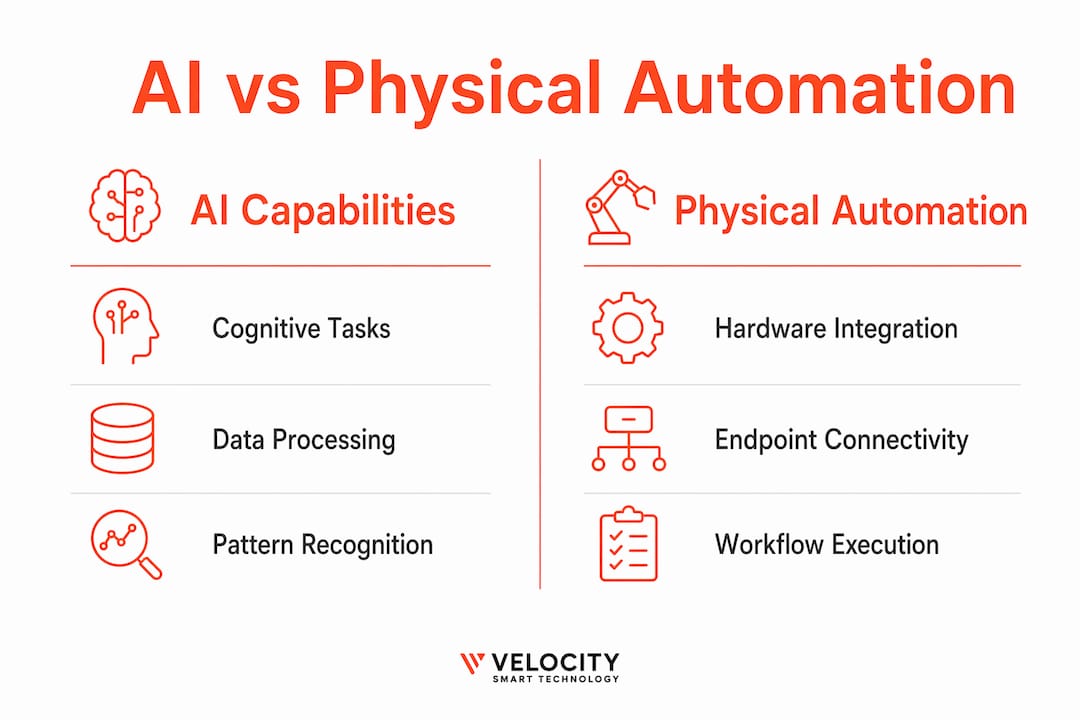
Velocity-smart closes the gap AI cannot cross alone
Physical IT service automation that actually works requires a hardware endpoint wired natively into ServiceNow, not bolted on via middleware. Velocity-smart’s Smart Collect® platform is the only ServiceNow-certified application that lets AI agents close physical-handover tickets without dispatching an engineer. Smart Lockers, Smart Vending, and Smart Kiosk™ all run from a single platform inside your existing ServiceNow tenant, inheriting your RBAC, audit trail, and CMDB. A global pharma customer achieved 500%+ IT service throughput uplift and 83% faster fulfilment before Now Assist was driving the workflow. As agentic AI matures, those results are the floor. Velocity-smart is ISO 9001 and ISO 27001 certified. To see how the AI-Physical Bridge applies to your environment, visit velocity-smart.com/why-velocity.

Key takeaways
The most important fact for enterprise IT leaders: AI cannot close physical IT service tickets without a hardware endpoint natively integrated into your ITSM platform.
| Point | Details |
|---|---|
| Physical access is the hard limit | AI agents cannot operate hardware or dispense devices without an integrated physical endpoint. |
| Governance gaps compound fast | Premature AI deployment without mature controls creates audit failures and asset loss in physical workflows. |
| Native ServiceNow integration matters | Embedding physical automation inside ServiceNow inherits existing RBAC, CMDB, and audit trails with no data sync. |
| Baseline results are already proven | A UK utility cut equipment loss and damage by 90% using Smart Collect® before AI drove the workflow. |
| Velocity-smart is the physical endpoint | Smart Collect® is the only ServiceNow-native platform that lets AI agents close physical-handover tickets autonomously. |
Recommended
See what Smart Collect® could save you
Model your savings in two minutes, or book a 60-minute workshop to pressure-test the numbers against your estate.