
How to upgrade IT asset distribution for enterprise IT
TL;DR:
- Integrating physical asset distribution into ServiceNow as native CIs enhances process automation, security, and auditability. Pilot programs show measurable improvements in throughput, fulfillment time, and staff productivity, especially with continuous discovery. Implementing vendor-validated, real-time CI updates ensures data accuracy and operational efficiency across diverse infrastructure scenarios.
The single most effective step you can take right now is to adopt a ServiceNow-native AI–Physical Bridge approach: make every smart locker, vending unit, and kiosk a first-class configuration item (CI) in your CMDB, and bind every physical handover to a ServiceNow ticket. Pilot Smart Collect® integrated with ServiceNow, with continuous discovery enabled from day one and a single ticket-to-dispense workflow. The architecture is ISO 9001 and ISO 27001 certified, and it runs natively inside your existing ServiceNow tenant — no parallel database, no middleware layer, no fresh security review.
- Adopt a ServiceNow-native integration — physical endpoints must write CI records directly into your CMDB on every transaction, not into a vendor-managed silo.
- Pilot Smart Collect® across one to three sites before committing to full rollout; measure throughput, fulfilment time, and staff-time reclaimed as your gating criteria.
- Enforce ticket-bound dispense — no handover without an associated ServiceNow request or incident record; this makes audit trails automatic.
Table of Contents
- What modernising your distribution stack actually delivers
- The technical building blocks of a modern physical distribution stack
- A pragmatic upgrade roadmap: phases, timelines, and cost drivers
- Integration, security, and compliance checklist for UK enterprise deployments
- How to build the business case: a compact ROI model
- Frequent implementation traps and how to prevent them
- Vendor and procurement checklist: the right questions to ask suppliers
- Key takeaways
- The implementer’s perspective
- Smart Collect® maps directly to this upgrade — request a pilot
- Useful sources and further reading
What modernising your distribution stack actually delivers
The business case for upgrading physical IT asset distribution rests on six measurable KPIs: cost-to-serve per ticket, fulfilment time, throughput, IT staff time reclaimed, asset loss and damage rate, and licence reconciliation accuracy. Each one moves materially when physical endpoints are integrated natively with your ITSM platform.
ServiceNow guidance is explicit: automate the end-to-end asset lifecycle and run workflows from the ServiceNow AI Platform to remove manual inefficiencies. When physical handovers are ticket-bound and CMDB-backed, licence drift and shadow IT shrink because every dispense event updates asset ownership in real time.
Documented outcomes from Smart Collect® deployments (delivered before agentic-AI drove the workflow): a global pharma customer recorded significant IT service throughput uplift, markedly faster fulfilment, and greatly reduced employee downtime. A UK utility significantly reduced shared-equipment loss and damage. A US nuclear energy operator reclaimed a substantial portion of IT staff time (calculated using a conservative model: 5,000 physical handover tickets per year, 45 minutes of engineer time per ticket, 60% shifted to automated endpoints, and an engineer cost of £45 per hour). These are the floor, not the ceiling, as Now Assist matures.
Continuous discovery compounds these gains. Gartner guidance recommends deploying automated tools that classify all assets so the CMDB reflects physical reality for hybrid and remote estates — replacing periodic audits with always-current inventory. When your CMDB is authoritative, vulnerability management, licence reconciliation, and audit preparation all accelerate.
The technical building blocks of a modern physical distribution stack
Three hardware form factors cover the full range of physical IT support scenarios:
| Form factor | Primary use cases | ITSM integration depth |
|---|---|---|
| Smart Lockers (e.g. Element Series) | New-starter kit delivery, broken-laptop hot-swaps, equipment loans and returns | Full CI write-back; ticket closed on collection |
| Smart Vending (e.g. IDEA Series) | Peripherals, consumables, accessories on demand | Dispense event creates or updates CI; licence count adjusted |
| Smart Kiosk™ | Walk-up support, AI-powered video resolver group, replaces traditional tech bar | Incident or request record updated; escalation routed in ServiceNow |
The orchestration layer is where most programmes succeed or fail. HP Workforce Experience analysis confirms that smart lockers and kiosks eliminate manual record-keeping by updating device ownership and state on each transaction — but only when the integration is native, not middleware-dependent. A native ServiceNow application inherits your existing RBAC, audit trail, and security posture. Middleware adds a synchronisation lag, a second attack surface, and an additional vendor to review.
Discovery sources you need in place before go-live: agent-based discovery, network discovery, UEM/EMM enrolment automation, barcode or RFID scanning at the endpoint, and CMDB relationship mapping. Lansweeper describes this as automatic discovery and cataloguing that feeds trusted data to ITSM, CMDB, and security tools simultaneously.
Security primitives are non-negotiable: role-based access control (RBAC), tamper detection and tamper-evident audit logs, encryption in transit and at rest, and a secure chain of custody for every dispensed asset.
Pro Tip: Map the data flow before you select hardware. Confirm that each endpoint writes a native CI record into ServiceNow on every transaction — not a batch export at midnight. That single architectural decision determines whether your CMDB stays authoritative or drifts within weeks.
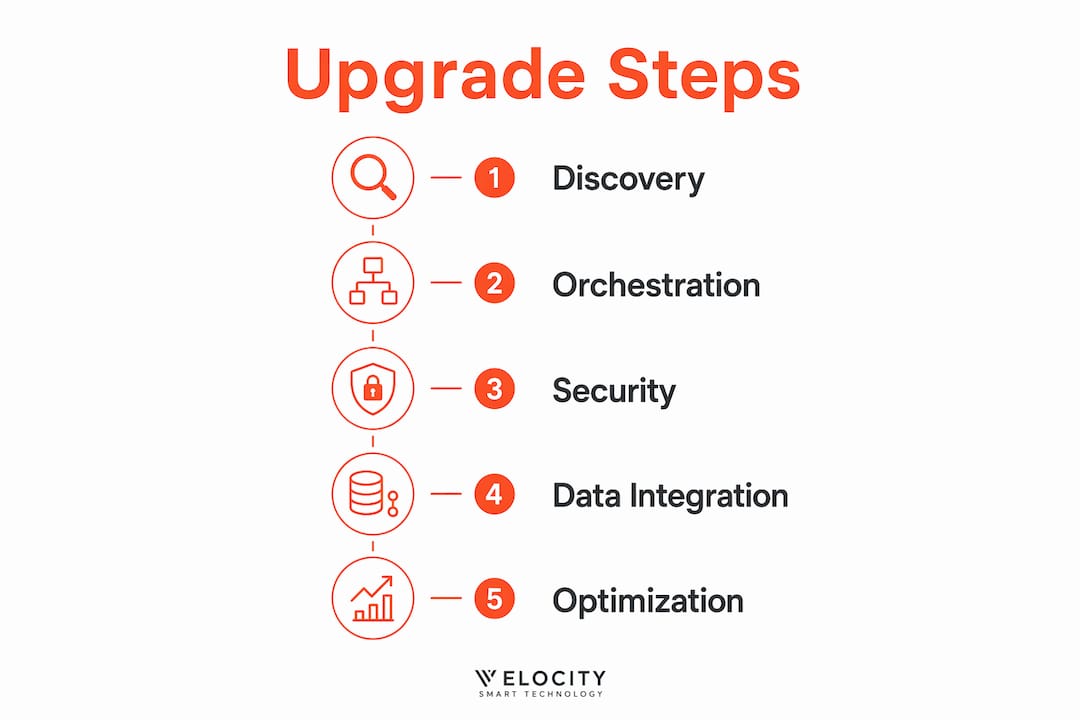
A pragmatic upgrade roadmap: phases, timelines, and cost drivers
Phases and typical durations
- Discovery and baseline (weeks 1–4): audit current asset inventory using agent-based and network discovery; establish baseline KPIs for cost-to-serve, fulfilment time, and throughput; identify pilot sites and stakeholder sign-offs (security, procurement, facilities).
- Pilot design (weeks 5–8): select form factors per site; configure ServiceNow native app; define ticket-to-dispense workflows; set success metrics and rollback criteria.
- Pilot execution (weeks 9–20, one to three sites): deploy hardware; validate CMDB write-back on every transaction; measure against baseline KPIs; conduct user adoption sessions.
- Scale and optimise (weeks 21+): apply pilot learnings; expand to additional sites; integrate predictive maintenance and fleet health monitoring.
| Phase | Typical duration | Gating criterion to proceed |
|---|---|---|
| Discovery and baseline | 4 weeks | Baseline KPIs documented; sites selected |
| Pilot design | 4 weeks | ServiceNow workflows validated in dev/test |
| Pilot execution | 8 weeks | Success metrics met; rollback plan tested |
| Scale and optimise | Ongoing | Pilot ROI confirmed; procurement framework agreed |
Primary cost drivers
- Hardware per unit (locker, vending, kiosk) and site installation works
- Integration engineering (lower for native apps; higher for middleware)
- Systems integrator or channel partner fees
- ServiceNow application licences and maintenance
- Logistics: spare-part provisioning, firmware updates, on-site support SLAs
Integration, security, and compliance checklist for UK enterprise deployments
UK enterprise deployments carry specific obligations around data residency, audit trail completeness, and supply-chain security. Work through this checklist before signing off on any vendor.
Integration:
- ServiceNow certified native application confirmed (not a third-party API wrapper)
- CMDB write-back on every dispense event, not batch synchronisation
- Continuous discovery sources active: agent-based, network, UEM/EMM, barcode/RFID
- Asset records queryable as standard CIs alongside all other configuration items
Security and compliance:
- ISO 27001 certification evidenced for the vendor and hosting environment
- RBAC model documented and mapped to your existing ServiceNow roles
- Encryption in transit (TLS 1.2 minimum) and at rest confirmed
- Tamper-detection hardware and tamper-evident audit logs active
- Secure chain of custody: each dispense record contains ticket ID, timestamp, user identity, asset serial number, and 2FA or PIN confirmation
A compliant dispense record must contain at minimum: ServiceNow ticket ID, date and time, authenticated user identity, asset serial number, firmware version at time of dispense, and a digital signature or 2FA confirmation. Safe Security notes that continuous discovery and inventory management are foundational for vulnerability management — a static inventory creates blind spots for unmanaged devices within hours of a dispense event.
Statistic: InvGate research recommends combining multiple discovery methods — agent-based, network, integrations, and manual imports — and normalising data to maintain a current, usable inventory linked to tickets. Organisations that rely on a single discovery method consistently report inventory gaps that surface only during audits.
How to build the business case: a compact ROI model
Finance and the C-suite need numbers, not narratives. Use these formulae as your starting point.
- Cost-to-serve per ticket: (total IT support staff cost + facilities overhead) ÷ annual ticket volume. Benchmark your current figure, then model the reduction as automated endpoints absorb a defined percentage of physical handover tickets.
- Fulfilment time reduction: (current average fulfilment time in hours) minus (target fulfilment time post-automation). Multiply by average hourly cost of employee downtime to express in pounds.
- Staff time reclaimed: (number of physical handover tickets per year) × (average engineer time per ticket in hours) × (percentage shifted to automated endpoints) × (engineer hourly cost).
Conservative worked example: assume 5,000 physical handover tickets per year, 45 minutes of engineer time per ticket, 60% shifted to automated endpoints, and an engineer cost of £45 per hour. Staff time reclaimed can be calculated based on number of physical handover tickets, average engineer time per ticket, percentage shifted to automated endpoints, and engineer hourly cost. Set that against hardware and integration costs to calculate payback period.
Sensitivity levers: utilisation rate of endpoints (higher utilisation compresses payback), ticket volume migrated from the tech bar, and maintenance contract structure. Predictive maintenance and fleet health monitoring reduce unplanned downtime costs and extend asset lifespans, improving the ROI model further.
Frequent implementation traps and how to prevent them
- Creating a parallel database: contracting physical distribution through facilities or a third party without native ITSM integration generates a second asset record system. Audit fatigue follows within months. Require contractual CMDB write-back SLAs before any hardware is ordered.
- Weak CMDB integration: batch synchronisation is not integration. Validate that every dispense event triggers a real-time CI update in ServiceNow; test this in a dev environment before pilot go-live.
- Ignoring continuous discovery: a point-in-time audit is outdated before the spreadsheet is saved. Deploy automated discovery agents alongside physical endpoints from day one.
- Underestimating last-mile logistics: hardware delivery, site preparation, power, network connectivity, and spare-part provisioning are consistently undercosted. Build a logistics line item into every site budget.
- Poor change management: end users who do not understand the new dispense workflow revert to emailing the service desk. Run adoption sessions before go-live; publish clear self-service instructions at each endpoint.
- Misaligned stakeholder ownership: procurement, facilities, and security each own a slice of the physical distribution lifecycle. Define ownership of each lifecycle stage in writing before the pilot begins.
Vendor and procurement checklist: the right questions to ask suppliers
- How is each dispense event logged back to the ServiceNow CMDB — native write or batch export?
- Can you push real-time CI updates, including ownership change and location, on every transaction?
- What failure modes exist if the ServiceNow connection drops — does the endpoint queue transactions or lock out users?
- Provide evidence of ISO 27001 and ISO 9001 certification for your platform and hosting environment.
- Describe your RBAC model and how it maps to existing ServiceNow roles without requiring a separate identity store.
- What encryption standards apply in transit and at rest, and what is your physical tamper-detection mechanism?
- Where is data hosted, and does it remain within the UK or EU at all times?
- What are your hardware uptime SLAs, and how are spare parts provisioned in the UK?
- Provide two UK or European systems integrator references who have co-delivered a pilot-to-scale programme.
- How is pilot-to-scale pricing structured — per endpoint, per transaction, or per site?
Pro Tip: Ask every vendor to demonstrate a live dispense transaction in a ServiceNow dev instance and show the resulting CI record in the CMDB before you sign a pilot agreement. A vendor who cannot demo this in under 30 minutes does not have a native integration.
Key takeaways
Treating physical distribution endpoints as first-class CIs in ServiceNow — not as peripheral hardware managed outside your ITSM platform — is the single architectural decision that determines whether your upgrade programme delivers measurable, auditable outcomes or creates operational debt.
| Point | Details |
|---|---|
| Make endpoints first-class CIs | Every smart locker, vending unit, and kiosk must write native CI records into ServiceNow on each transaction — no parallel databases. |
| Prioritise continuous discovery | Replace periodic audits with always-on discovery agents; static inventories create security blind spots and licence drift within days. |
| Bind every handover to a ticket | Ticket-to-dispense workflows make audit trails automatic and licence reconciliation accurate without manual data entry. |
| Design pilots with clear KPIs | Measure throughput uplift, fulfilment time reduction, and cost-to-serve before scaling; use these as gating criteria for roll-out approval. |
| Velocity-smart as the AI–Physical Bridge | Smart Collect® is the ServiceNow-certified native application that implements all four patterns above, with documented outcomes across regulated UK and global industries. |
The implementer’s perspective
The pattern that separates programmes that scale from those that stall is deceptively simple: every physical handover must close a ticket, not open a spreadsheet. Pilots that instrument this from day one accumulate audit data, licence reconciliation accuracy, and CMDB integrity automatically. Those that defer it — planning to “clean up the data later” — rarely do.

The pharma case is instructive precisely because the outcomes were achieved before agentic AI drove the workflow. A global pharma deployment of Smart Collect® recorded 500%+ IT service throughput uplift, 83% faster fulfilment, and 74% less employee downtime using conventional ServiceNow ITSM workflows — these figures are the documented floor as Now Assist matures. The AI–Physical Bridge framing matters here: as Now Assist and agentic-AI orchestration mature, these documented results represent the baseline rather than the ceiling. The organisations that have already made physical endpoints first-class CIs will absorb that capability without re-engineering their stack. Those still running manual handovers will face a structural cost disadvantage that compounds each year.
The last-mile closure problem is real and underestimated. Digital workflows are fast; physical logistics are not. The gap between a ServiceNow ticket being raised and a device reaching an employee’s hands is where cost accumulates and employee experience degrades. Smart lockers, vending units, and kiosks close that gap — but only when they are architected as ITSM extensions, not as facilities hardware with an API bolted on.
Smart Collect® maps directly to this upgrade — request a pilot
Smart Collect® is the only ServiceNow-certified native application that manages smart lockers, vending units, and kiosks as first-class CIs inside your existing ServiceNow tenant. There is no middleware, no parallel database, and no separate vendor security review — workflows, RBAC, audit trails, and CMDB records all live where the rest of your ITSM estate lives.
Velocity-smart is UK-headquartered, ISO 9001 and ISO 27001 certified, and has delivered documented outcomes across regulated industries including pharma, energy, defence, legal services, and financial services in the UK and globally. Approximately 55% of deployments are channel-led through ServiceNow Service Specialist Partners including Atos, DXC, SCC, SHI, Vohkus, and Teceze.
To request a pilot, visit the IT asset lockers page or contact the Velocity-smart team directly to scope your first site, define your success metrics, and agree a pilot-to-scale pricing model.
Useful sources and further reading
- ServiceNow IT Asset Management — authoritative guidance on automating asset lifecycle workflows and running ITSM-native dispense processes; use when drafting integration requirements.
- Gartner cost optimisation / IT guidance — Gartner’s framework for continuous discovery and CMDB authoritativeness in hybrid estates; use when building the security and compliance section of your RFP.
- Lansweeper IT Asset Management — practical reference for multi-source discovery architecture (agent, network, cloud); use when specifying discovery sources in your technical spec.
- Safe Security — Asset Inventory Management — covers the security risk of static inventories and the case for continuous discovery; use in your security checklist and risk register.
- InvGate — IT Asset Inventory — step-by-step guidance on building a staged discovery approach and linking assets to tickets; use when designing pilot data collection.
- HP Workforce Experience — IT Asset Lifecycle — analysis of smart locker and kiosk form factors and their role in eliminating manual record-keeping; use when justifying form factor selection to stakeholders.
- Velocity-smart — Global Pharma Case Study — documented outcomes (500%+ throughput, 83% faster fulfilment, 74% less downtime) from a regulated-industry Smart Collect® deployment; use as a benchmark when building your business case.
Recommended
See what Smart Collect® could save you
Model your savings in two minutes, or book a 60-minute workshop to pressure-test the numbers against your estate.