
Seven steps to improve employee experience in enterprise IT
TL;DR:
- Automating physical device handovers significantly improves employee experience and reduces IT support costs.
- Launching a focused pilot with clear KPIs and ServiceNow-native solutions accelerates measurable gains within weeks.
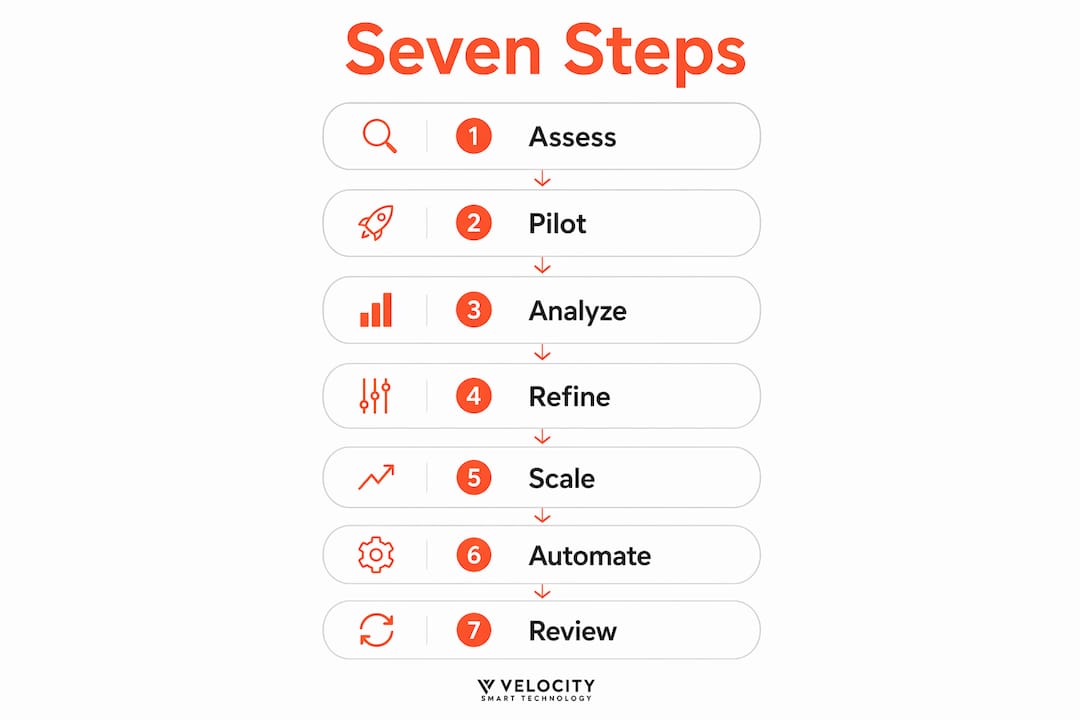
The fastest, most measurable way to improve employee experience in a distributed enterprise is to follow a seven-stage lifecycle: assess → define goals → map the journey → prioritise friction → align leadership → implement in phases → monitor with KPIs. Device distribution automation belongs at stage four, but it should be your first pilot. Automating physical IT support through ServiceNow-native tools such as Smart Collect® by Velocity Smart Technology produces measurable uplift in mean time to resolution (MTTR), adoption rate, and employee downtime before any wider cultural programme has time to land.
Immediate next actions for IT leaders:
- Pull your current MTTR and ticket-volume split (physical vs digital) from ServiceNow this week.
- Identify the two or three sites with the highest volume of device-swap and new-starter provisioning tickets.
- Confirm your ServiceNow release version and RBAC configuration before any vendor conversation.
- Set a pilot acceptance gate: target MTTR reduction and adoption rate at the six-week mark.
Table of Contents
- Why employee experience in IT is a strategic lever right now
- The seven-stage EX improvement lifecycle, step by step
- How automating device distribution removes friction faster than digital fixes
- Practical implementation checklist for UK enterprises
- KPIs to measure pilot success and scale readiness
- Phased rollout roadmap: from pilot to enterprise scale
- How to choose a solution: evaluation criteria and red flags
- Key takeaways
- A practitioner’s view for CIOs and IT leaders
- Smart Collect® closes physical-handover tickets inside ServiceNow
- Authoritative sources and further reading
Why employee experience in IT is a strategic lever right now
Employee experience (EX) research consistently links positive experience to higher retention intent and stronger individual performance. McKinsey findings reinforce the same pattern: employees who report a positive experience are materially more engaged and more likely to stay. For enterprise IT leaders, that translates directly into a workforce that is productive on day one, not day thirty.
Physical IT friction is the hidden tax on employee experience. A missing laptop at onboarding, a three-day wait for a peripheral swap, or a repeat engineer visit for a broken device each erodes trust in the organisation before a single HR initiative has a chance to register.
Organisations that prioritise EX report measurable productivity gains and lower voluntary turnover, but only when programmes carry executive ownership and cross-functional alignment. The operational cost argument is equally direct: desktop support tickets cost roughly three times more than digital ones, and as AI collapses digital cost-to-serve, the physical layer becomes the line item that dominates the IT budget conversation. Automating device provisioning and onsite swaps is therefore both an EX improvement and a cost-reduction play. The enterprise IT support trends shaping 2026 decision cycles all point the same direction.
The seven-stage EX improvement lifecycle, step by step
A practical, repeatable approach to improving employee experience follows seven stages. Each stage builds on the last; skipping stage one makes every subsequent stage harder to justify to a board.
-
Assess the current state. Run pulse surveys alongside ServiceNow ticket analytics. Segment by site, role, and device type to surface where friction concentrates. Assign this to your service-desk analytics lead; target a two-week data pull.
-
Define measurable goals. Commit to specific KPIs before any spend: MTTR target, adoption rate threshold, reduction in employee downtime, and voluntary turnover trend. Vague goals produce vague results.
-
Map the employee journey and touchpoints. Gallup’s research frames this as walking the lifecycle from the employee’s perspective, not the IT team’s. Map attraction, onboarding, day-to-day support, and offboarding. Device provisioning appears at onboarding and recurs at every equipment lifecycle event.
-
Prioritise high-impact friction points. Device provisioning, onsite swaps, and equipment returns consistently rank as the highest-volume, highest-frustration touchpoints in distributed enterprises. This is where your pilot should land. Automation in employee onboarding is the fastest path to a measurable early win.
-
Align leadership, HR, and frontline managers. Gallup data shows managers account for 70% of the variance in team-level engagement. Equip them with visibility into device status and ticket resolution, not just headcount metrics.
-
Implement phased improvements. Pilot a single site or cohort (6–12 weeks), validate KPIs, then scale regionally. Phased delivery limits risk and gives you a defensible evidence base for the next budget cycle.
-
Monitor and adjust with KPIs. A continuous listening and analytics engine that closes the loop from feedback to automated action prevents survey fatigue. Tie feedback channels to workflow resolution, not just reporting dashboards.
Pilot success gates (six-week check): MTTR trending down, adoption rate above your agreed threshold, zero security incidents, and at least one site manager reporting reduced escalations.
How automating device distribution removes friction faster than digital fixes
Automating the physical layer resolves a category of friction that surveys identify but digital-only fixes cannot touch. When a new starter arrives and their laptop is not ready, no amount of improved onboarding content compensates. The friction is physical, and the fix must be physical.
Common friction types that smart lockers, kiosks, vending units, and ServiceNow-native workflows address directly:
- Missing hardware at onboarding: smart lockers deliver pre-configured devices on day one, without an engineer present.
- Slow fulfilment for peripheral swaps: Smart Vending (IDEA Series) dispenses accessories on demand, 24/7.
- Repeat engineer visits: Smart Kiosk™ replaces the walk-up tech bar with an AI-powered video resolver, cutting repeat dispatches.
- Returns handling and asset loss: automated returns workflows in ServiceNow update the CMDB in real time, eliminating manual reconciliation.
Pro Tip: Engage your site operations and physical security teams in week one of the pilot scoping, not week six. Locker placement, power supply, and access-control integration are the most common causes of pilot delays in UK enterprise deployments.
A global pharma customer running Smart Collect® recorded a 500%+ uplift in IT service throughput, 83% faster fulfilment, and 74% less employee downtime. Those results were achieved using traditional ITSM workflows, before agentic AI entered the picture. A UK utility using the same platform cut shared-equipment loss and damage by 90%. The pattern holds across sectors: automating the physical handover layer produces outsized EX gains relative to the investment required.
Continuous listening without an automated action loop creates survey fatigue. Tie feedback channels to automated fulfilment workflows so that the friction employees report is resolved, not just recorded.
For a practical view of workplace self-service models and how kiosk and locker patterns fit into a broader ITSM architecture, the linked guide covers the operational design in detail.

Practical implementation checklist for UK enterprises
This checklist takes you from procurement decision to first transaction in a typical 6–12 week pilot window.
Site and infrastructure readiness:
- Confirm power supply and network connectivity at proposed locker/kiosk locations.
- Verify physical security requirements with your facilities and security teams.
- Confirm GDPR data flows: identify what personal data the system will process, the legal basis, and your data retention schedule.
- Check that your ServiceNow release version is compatible with the certified application.
Security and compliance:
- Require ISO 9001 and ISO 27001 certification from any hardware or platform supplier.
- Confirm the application runs natively inside your ServiceNow tenant with no parallel database or external data sync. Review Smart Collect® security and compliance architecture as a reference standard.
- Validate RBAC configuration: locker access permissions should inherit your existing ServiceNow roles.
- Confirm CMDB linkage: every device transaction must write to your CMDB as a native record.
Supplier questions for RFP or demo:
| Question | What a strong answer looks like |
|---|---|
| Is this a ServiceNow-certified application? | Yes, listed on the ServiceNow Store, tracks release schedule |
| Where does asset and transaction data reside? | Inside the customer’s ServiceNow tenant only |
| How are firmware and security updates managed? | Vendor-managed, with defined SLA and change-control process |
| What audit log data is available? | Full transaction history queryable as native CMDB records |
| What is the spares and hardware support model in the UK? | Named UK support contact, defined response SLA |
KPIs to measure pilot success and scale readiness
Track five core metrics from day one. Define them before the pilot starts so your go/no-go decision at week six is data-driven, not anecdotal.
| KPI | Definition | Pilot target | Scale target |
|---|---|---|---|
| MTTR (physical tickets) | Mean time from ticket open to device in employee’s hands | Establish baseline; target reduction | Sustained reduction vs pre-pilot baseline |
| Adoption rate | % of eligible transactions completed via automated channel | >60% by week six | high adoption rate at scale |
| Employee downtime | Hours lost per employee per device event | Reduce vs baseline | Track trend quarterly |
| Cost per physical ticket | Total physical support cost divided by ticket volume | Establish baseline | Target reduction as volume shifts to automated channel |
| Return rate compliance | % of device returns completed on time via automated workflow | >70% | >90% |
Collect MTTR and ticket-volume data directly from ServiceNow. Adoption rate comes from locker/kiosk transaction logs, which Smart Collect® surfaces as native ServiceNow reports. The IT Support Survey 2026 provides UK enterprise benchmark data useful for calibrating your pilot targets against peer organisations.
Dashboard fields to require from your platform: live MTTR by site, adoption rate per location, ticket-volume split (physical vs digital), return-rate compliance, and open vs resolved physical tickets by age.
Phased rollout roadmap: from pilot to enterprise scale
Start with one site or a defined cohort. Validate KPIs. Then scale in regional tranches.
| Phase | Timeline | Key activities | Go/no-go gate |
|---|---|---|---|
| Pilot | Weeks 1–12 | Single site, RBAC config, CMDB linkage, staff comms | MTTR reduction confirmed, adoption >60%, zero security incidents |
| Regional expansion | Months 3–12 | Roll to 3–5 sites, refine workflows, manager enablement | Adoption >70%, cost-per-ticket trending down, security sign-off |
| Enterprise scale | Months 12–24 | Full estate, integrate with Now Assist workflows, quarterly KPI review | Adoption >80%, MTTR at target, CFO-level cost case confirmed |
Role matrix for pilot governance:
| Role | Responsibility |
|---|---|
| IT operations lead | ServiceNow configuration, CMDB, RBAC |
| Facilities | Site readiness, power, physical security |
| HR | Onboarding workflow alignment, manager comms |
| Information security | GDPR sign-off, ISO compliance check |
| Vendor (e.g. Velocity Smart Technology) | Hardware installation, application configuration, SLA |
How to choose a solution: evaluation criteria and red flags
Prioritise ServiceNow-native applications over API integrations or middleware layers. A native application inherits your existing RBAC, audit trail, and CMDB without a parallel database, which means no additional security review scope and no data-sync risk.
Vendor evaluation checklist:
- ServiceNow Store certification confirmed (not self-certified).
- Application runs inside your tenant; no external database.
- RBAC permissions inherit existing ServiceNow roles.
- Full CMDB linkage: every transaction writes a native configuration item record.
- Defined firmware and security update SLA.
- UK-based support with named contacts and response time commitments.
- ISO 9001 and ISO 27001 certification for both platform and hardware.
Questions to ask during an RFP or demo:
- Can you demonstrate the application running inside our ServiceNow sandbox?
- Where exactly does personal data reside, and how does it meet UK GDPR requirements?
- What is your ServiceNow release-track alignment process?
- How do you handle CMDB conflicts when a device changes state mid-transaction?
- What does your UK spares and hardware replacement model look like?
Red flags: a vendor who cannot demonstrate the application inside your tenant, references a “sync” between their database and ServiceNow, cannot confirm ISO 27001 certification, or is vague about RBAC inheritance. These are architectural gaps, not configuration issues.
Smart Collect® by Velocity Smart Technology is a fully ServiceNow-certified application, ISO 9001 and ISO 27001 certified, with no parallel database. Asset state, device location, and audit data sit in the customer’s CMDB as native records. The role of automation in ITSM guide covers integration architecture in detail for IT leaders evaluating options.
Key takeaways
Automating physical IT support through a ServiceNow-native platform is the single highest-leverage step in a seven-stage EX improvement programme for distributed UK enterprises.
| Point | Details |
|---|---|
| Start with device automation | Physical IT friction is the highest-volume, highest-frustration EX gap; pilot smart lockers and kiosks first. |
| Define KPIs before spend | Set MTTR, adoption rate, and downtime targets before procurement; use these as your go/no-go gates. |
| Require ServiceNow-native architecture | No parallel databases, full RBAC and CMDB inheritance; confirm ISO 27001 certification from any supplier. |
| Align managers early | Managers account for 70% of team-level engagement variance; give them device-status visibility from day one. |
| Velocity-smart as the benchmark | Smart Collect® delivered 500%+ throughput uplift, 83% faster fulfilment, and 74% less downtime in a pharma deployment before agentic AI entered the workflow. |
A practitioner’s view for CIOs and IT leaders
The conventional wisdom on EX improvement programmes is that culture and leadership come first, and technology follows. That sequencing is right for long-cycle cultural change. It is wrong for the specific problem of physical IT friction in a distributed workforce.
A device-first pilot produces measurable EX wins within a single quarter, and those wins create the political capital to fund the longer cultural work. When a new starter receives their laptop on day one without an engineer visit, and when a broken device is swapped in twenty minutes via a locker rather than a three-day ticket queue, the effect on trust is immediate and visible to managers, HR, and the board. That is the kind of evidence that moves budget conversations.
The pragmatic trade-off is scope versus speed. A narrow pilot on one site with a clear KPI gate is faster to approve, faster to learn from, and faster to scale than a multi-site programme designed to be comprehensive from the start. The business case for workplace automation is strongest when it is specific: name the site, name the ticket type, name the target MTTR, and name the cost saving. Boards approve specifics; they defer generalities.
For the board-level ask, frame it this way: a six-week pilot on your highest-volume device-provisioning site, with a defined KPI gate, a named vendor with ISO 27001 certification and a ServiceNow Store listing, and a cost-per-ticket baseline established before day one. That is a defensible, time-bounded investment with a clear exit if the numbers do not land.
Smart Collect® closes physical-handover tickets inside ServiceNow
Physical IT support is the last unautomated layer in most enterprise ITSM stacks. Smart Collect® by Velocity Smart Technology is the only ServiceNow-certified application that closes physical-handover tickets natively, without dispatching an engineer and without a parallel database.
Verified customer outcomes, delivered on traditional ITSM workflows before agentic AI: 500%+ IT service throughput uplift (global pharma), 83% faster fulfilment, 74% less employee downtime, 90% reduction in shared-equipment loss (UK utility). ISO 9001 and ISO 27001 certified. Three hardware form factors: Smart Lockers for full-device handovers, Smart Vending for peripherals and consumables, Smart Kiosk™ for walk-up virtual support.
To understand the architecture and see the case studies, visit the Velocity Smart Technology product page. To discuss a pilot scoped to your ServiceNow environment and UK sites, the team at Velocity-smart can be reached directly through the same page.
Authoritative sources and further reading
- Gallup: Employee Experience and Workplace Culture — use for manager-impact data, lifecycle mapping methodology, and engagement variance statistics.
- Oracle: What Is Employee Experience? — Gartner-cited analyst framing for EX as a retention and performance lever.
- Qualtrics: Employee Experience Complete Guide — use for continuous listening, analytics, and closed-loop action frameworks.
- Moveworks: How to Create an Employee Experience Framework — practical framework tying people, process, and technology together.
- Happeo: Improve Employee Experience — use for productivity and turnover data and cross-functional alignment guidance.
- HRSimple: Employee Experience Strategy — step-by-step structure for implementation checklists and roadmap planning.
- Velocity Smart Technology: Global Pharma Case Study — 500%+ throughput uplift proof point for pilot business cases.
- Velocity Smart Technology: IT Support Survey 2026 — UK enterprise benchmark data for pilot KPI calibration.
- Velocity Smart Technology: How to Reduce IT Hardware Support Tickets — tactical playbook for reducing physical ticket volume before and during a pilot.
Recommended
See what Smart Collect® could save you
Model your savings in two minutes, or book a 60-minute workshop to pressure-test the numbers against your estate.